
AriZona Iced Tea’s New Artist Residency Is the Latest Chapter in Its Unconventional Brand Story
Any marketing executive will tell you that they care about their brand’s aesthetics, but it’s rare to find a corporation where the design language is as distinctive, long-lasting, and personal as AriZona Iced Tea — a commitment that has recently taken an unexpected turn.
AriZona Iced Tea entered the market in 1992 with cans featuring an eye-catching palette of teal and green and motifs inspired by the American Southwest, all of which still feature prominently everywhere from individual bottles and cans to the company’s website and sprawling merchandise store. Take away all the words and it’s still obvious which brand it is — the visual language is that distinctive. Even the company’s logo is essentially unchanged since 1992.
For consumers of the time, the maximalist Southwest style set the new products apart from the more formulaic packaging of competitors like Snapple and Nestea. It was all the more compelling because it built on the founders’ own stylistic preferences and vision, not those of focus groups and consultants.
“We designed it in-house with a scratch pad and pencils and markers, and came up with what we thought was a cool look,” co-founder Don Vultaggio told The Washington Post at the time, and his wife, Ilene, was the artist who inspired the cherry blossom motif on the packaging for the company’s green tea. Before getting into the beverage business, the couple had also incorporated Southwest themes in the interior design of their own home.
A New Chapter in Company Branding
“Art and design have always been an important part of AriZona’s visual identity,” says Spencer Vultaggio, AriZona’s present-day chief marketing officer (Don and Ilene’s son), explaining the company’s latest ventures in captivating aesthetics, which have recently focused on in-person experiences.
In 2024, a new facility called AriZonaLand opened its doors in Keasbey, N.J. as both a bottling plant and visitor center with over-the-top decor including indoor artificial trees, a floor covered in the teal-and-cherry-blossom pattern from the green tea cans, and all manner of pink and yellow accents.
“Having access to a genuine community of people whose common goal is to create together, support, and uplift each other is hard to come by these days.”
Over the last year-plus, AriZona has hosted an artist residency program at its headquarters in Woodbury, N.Y., with up to four artists in each six-week-long session. The first cohort began its residency in July 2025, and the program just wrapped up its third group this August, with four participants making art and building connections. The artists receive a stipend, living space, materials, and access to AriZona’s rooftop studio and shop.
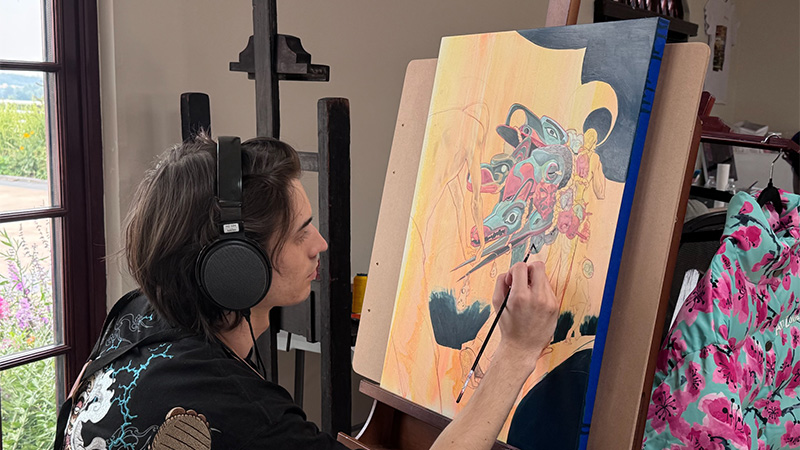
In keeping with the founders’ deeply personal approach to building the brand all those years ago, AriZona’s residency is truly immersive and hands-on, with participants working closely with each other and company creatives, with ideas allowed to flow freely and take unexpected turns.
“Having access to a genuine community of people whose common goal is to create together, support, and uplift each other is hard to come by these days,” Vultaggio says. “We hope this program fosters meaningful connections and helps alleviate some of the pressures of everyday life.”
There’s also a business angle: like AriZona’s famous commitment to keeping its cans of iced tea priced at 99 cents, the residency is an attention-grabbing way to set the company apart, using quirkiness as a competitive advantage and marketing tactic.
“I often take breaks to collaborate with the other artists, discuss our concepts, and offer feedback on each other’s work. It’s been fascinating to see how each person has mastered their own medium.”
“The program also reflects AriZona’s commitment to doing things differently,” Vultaggio says. “Inviting artists to work on site, giving them the time, space, resources, and creative freedom to make new work is something uncommon within the corporate world.”
A Day in the Life of an Artist in Residence
For the participants, the residency offers inspiration and connection. “I spend the day developing projects, experimenting with new ideas, and making the most of the full workday,” says Eleanor Dexter, a member of the most recent group, who has used the time to develop a collection of paintings and silkscreen projects. “I often take breaks to collaborate with the other artists, discuss our concepts, and offer feedback on each other’s work. It’s been fascinating to see how each person has mastered their own medium.”
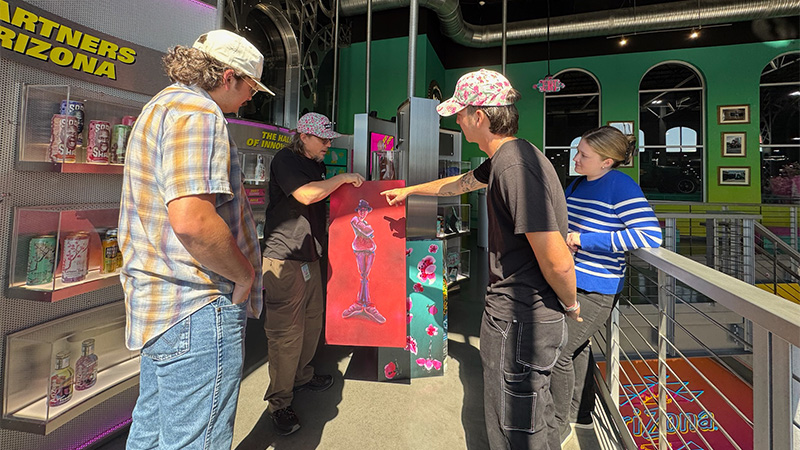
There’s also the physical workspace, a spacious workshop known as The Lookout, which AriZona’s own creative team also uses and is fully outfitted with tools and technology from computer workstations to a woodshop. Another member of the recent cohort, a textile, wood, and metal artist named Lucas Carlo Monasterio, has been working with one of AriZona’s employees on a project that involves laser-cutting leather, in addition to a sculpture involving wood and steel. “My dream is to work on a larger scale of community projects,” he says. “Working in the shop during this residency was a great first step.”
Building Careers, Building a Brand
As the artists work on their own projects and take the next steps in their own careers, they often draw inspiration from their surroundings. AriZona showcases the work in an exhibition at the end of each session and highlights its work on social media; the company also invites artists to contribute a piece to its permanent collection. The results are often a mix of both deeply personal expressions and nods to the corporate context, like large-scale reinterpretations of iced-tea cans or riffs on Ilene’s cherry-blossom pattern.
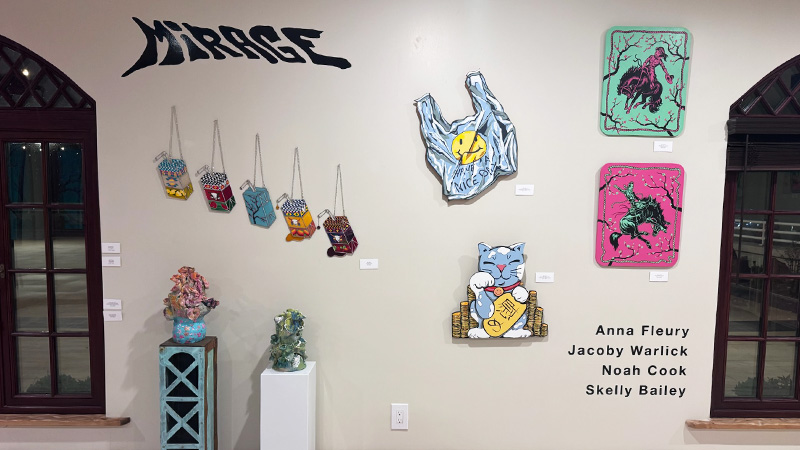
One recent participant, Anna Fleury, made a stained-glass window with a Southwest-inspired design featuring a cactus and cow skull, which is now the focal point of a door in the workspace. Fleury says she hadn’t even intended to work on stained glass before the residency — but once she was on-site and saw the tools and materials available, she felt inspired: “That led to a series of projects, including a cherry blossom stained glass panel, stained glass juice boxes with hand-painted enamel designs, stained glass hot air balloons, and a glass landscape inspired by the rooftop Lookout studio.”
Fleury’s work highlights the symbiosis at play in AriZona artist residency: it’s an ongoing dialogue between groups of artists and the brand itself, a way for everyone involved to play, create, and add to their legacy.
With all that work and all those conversations and collaborations, it’s natural that everyone needs a refreshment now and then — and, yes, AriZona does provide unlimited access to iced tea and other company products. (“I tried to work my way through as many AriZona flavors as I could during the residency!” says Fleury.) But unlike so many other corporate partnerships, those particular ice-cold beverages aren’t consumed for smiling photo-ops and overt endorsements; they’re savored as the starting point for something bigger for both the artists and the company.
The article AriZona Iced Tea’s New Artist Residency Is the Latest Chapter in Its Unconventional Brand Story appeared first on VinePair.